Kepler passes scientific tests
Posted: Fri, Aug 7, 2009, 8:04 AM ET (1204 GMT)
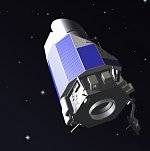 Observations of a star known to have an extrasolar planet have confirmed that a new NASA spacecraft should be able to detect Earth-sized worlds around other stars, scientists said Thursday. NASA used the Kepler spacecraft, launched earlier this year, to observe a star 1,000 light-years away where previous observations had detected a planet closely orbiting it. Kepler was able to detect the changes in brightness as the star transited across the star's disk, as well as a much smaller change when the planet passed behind the star. The high quality of the Kepler data also allowed scientists to infer additional data about the planet, including a temperature on its day side of 2,375 degrees Celsius. Kepler, launched in March, will spend the next three and a half years observing one region of the sky, looking for similar transits caused by other exoplanets, including worlds the size of the Earth.
Observations of a star known to have an extrasolar planet have confirmed that a new NASA spacecraft should be able to detect Earth-sized worlds around other stars, scientists said Thursday. NASA used the Kepler spacecraft, launched earlier this year, to observe a star 1,000 light-years away where previous observations had detected a planet closely orbiting it. Kepler was able to detect the changes in brightness as the star transited across the star's disk, as well as a much smaller change when the planet passed behind the star. The high quality of the Kepler data also allowed scientists to infer additional data about the planet, including a temperature on its day side of 2,375 degrees Celsius. Kepler, launched in March, will spend the next three and a half years observing one region of the sky, looking for similar transits caused by other exoplanets, including worlds the size of the Earth.
Related Links:
| <<previous article | next article>> |
|
news in brief
|
|
|
|
news links
|
|
Tuesday, October 13
Space weather mission Sawa reveals Polish roots
ESA — 1:05 am ET (0505 GMT) A Successful Second Edition of ESA Open Days at ESA Headquarters in Paris
ESA — 1:04 am ET (0504 GMT) Poland says two Turkish nationals detained in Germany over Starlink station fire
TVP World — 1:04 am ET (0504 GMT) Korea Joins ESA Mission to Track Jupiter Probe JUICE
Seoul Economic Daily — 1:03 am ET (0503 GMT) Poland says two Turks arrested over Russia-linked Starlink station fire
Aljazeera — 1:01 am ET (0501 GMT) |
