
|
Astronomers weigh extrasolar planet
Posted: Tue, Dec 3, 2002, 6:26 PM ET (2326 GMT) 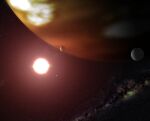 Astronomers announced Tuesday that they have used data from the Hubble Space Telescope to pin down the mass of an extrasolar planet. The astronomers, led by George F. Benedict and Barbara McArthur of the University of Texas, used Hubble's Fine Guidance Sensors, normally used to help point and stabilize the telescope, to measure minute wobbles in the star Gliese 876, a star 15 light-years away around which astronomers had previously discovered two exoplanets. The radial velocity technique used to discover the planets could only provide a minimum mass for the planets since the inclination of the star system as seen from the Earth was unknown. Astronomers linked the wobbles seen by Hubble to the outer planet, Gliese 876b, allowing astronomers to measure its inclination. Gliese 876b was previously given a minimum mass of 1.9 Jupiter masses; the Hubble data shows the planet's orbit is only slightly inclined, giving the planet a mass between 1.89 and 2.4 Jupiter masses. The discovery, to be published in the December 20 issue of Astrophysical Journal Letters, is the first time this technique has been used to more precisely measure the mass of an exoplanet. Gliese 876b is only the second exoplanet whose mass has been precisely measured in any way.
Related Links:
|
|
|
about spacetoday.net · info@spacetoday.net · mailing list |
